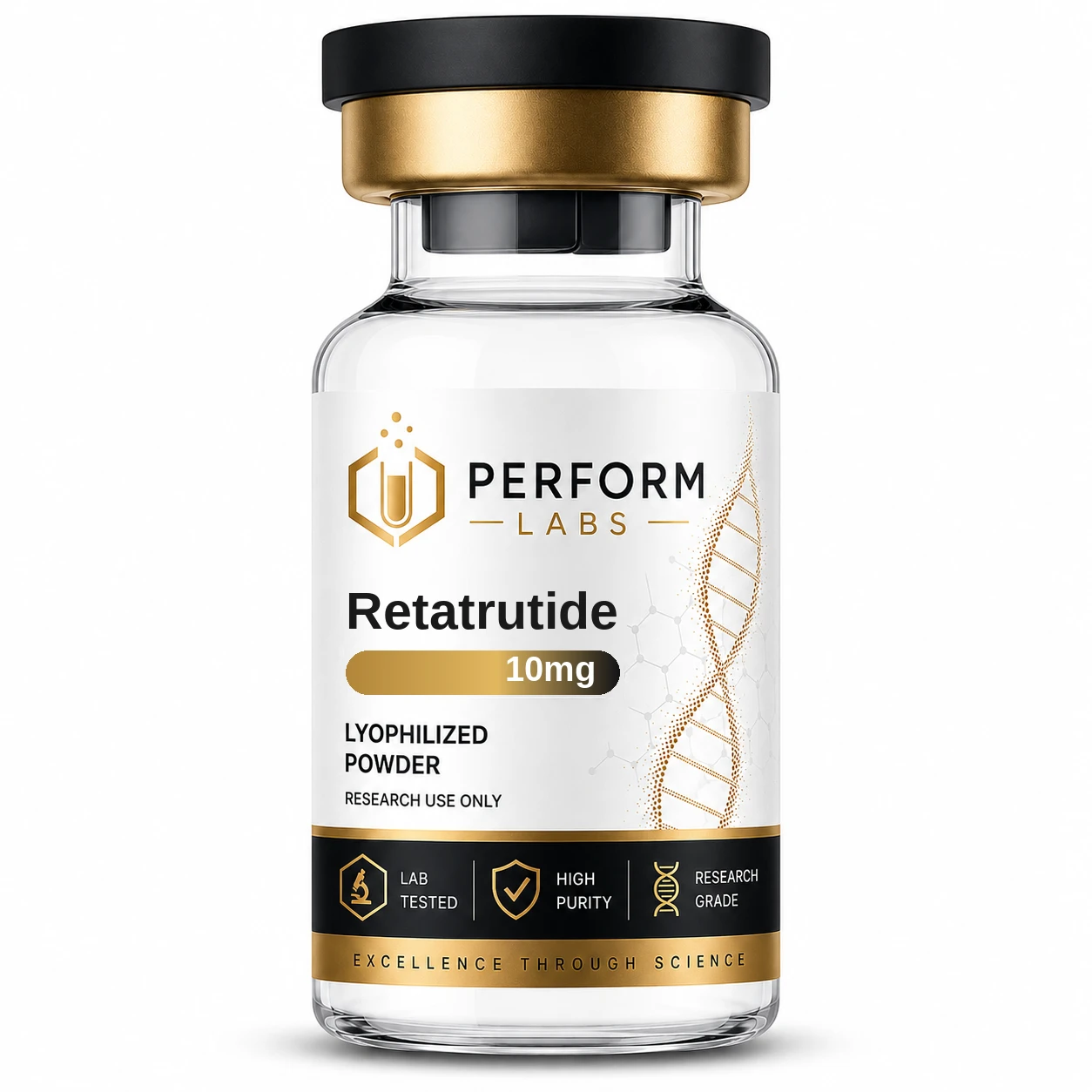
Everything an Australian research team needs before starting a Retatrutide study — mechanism, published data, molecular weight, stability and COA verification.
Retatrutide has moved faster through Australian research circles than almost any incretin-class peptide before it. Labs are drawn to the compound because it is the first widely available triple agonist — engaging GIP, GLP-1 and glucagon receptors in a single molecule — and because the published Phase 2 data set is unusually large for a compound still this early in its research lifecycle. This guide sets out what the molecule is, how it behaves analytically, and what documentation Perform Labs expects a research-grade batch to carry.
Because Retatrutide is newer to the Australian market than tirzepatide or semaglutide, sourcing decisions carry more risk if a supplier cannot produce independent verification. Everything below is structured so a research coordinator can use it as a checklist before a batch enters a study protocol.
What is Retatrutide?
Retatrutide is a synthetic peptide built on a modified GIP backbone carrying two fatty acid attachment points, which extends its plasma half-life via reversible albumin binding and supports the once-weekly administration interval used throughout the published clinical literature. Unlike single- or dual-receptor incretin analogues, Retatrutide is engineered to activate three separate receptor systems concurrently, which is why it is frequently described in the literature as a 'triple agonist'.
Mechanism of action
- Simultaneous agonism at the GIP, GLP-1 and glucagon receptors — three distinct class B GPCRs.
- Glucagon receptor engagement is the structural feature that differentiates Retatrutide from dual GIP/GLP-1 agonists and is linked in published models to increased energy expenditure.
- Fatty-diacid modification supports sustained albumin binding, giving a circulating half-life researchers report at roughly 6 days.
- Downstream cAMP signalling across all three receptor systems is the basis for the metabolic endpoints reported in Phase 2 publications.
Molecular identity and structure
Retatrutide is a large, chemically modified peptide with an average molecular mass in the region of 4731 Da. Confirming this mass by LC-MS against the theoretical value is the single most important identity check a laboratory can run before proceeding with any downstream in-vitro work, since a mismatch of even a few daltons typically indicates truncation, oxidation, or an incomplete synthesis.
Published research data snapshot
The Phase 2 dose-ranging study published in the New England Journal of Medicine remains the most cited data source for Retatrutide and is the reference point most Australian research teams use when designing comparative or follow-up in-vitro work. The table below summarises the weekly dose tiers referenced across that literature, provided purely as a research data point.
| Study Arm | Reference Weekly Dose | Duration Referenced |
|---|---|---|
| Arm 1 | 1 mg | 48 weeks |
| Arm 2 | 4 mg | 48 weeks |
| Arm 3 | 8 mg | 48 weeks |
| Arm 4 | 12 mg | 48 weeks |
Reconstitution and stability behaviour
Lyophilised Retatrutide is reconstituted with bacteriostatic water using slow addition down the vial wall, avoiding agitation that can encourage aggregation. Published storage references for this compound class describe reconstituted material as stable for approximately 28–30 days under refrigeration at 2–8°C, while lyophilised powder is documented as stable for 24 months or longer at -20°C when protected from light and moisture.
Handling checklist for Australian labs
- Log ambient transit time on arrival — Perform Labs dispatches same day (orders cleared by 2pm AEST) via Auspost Express to minimise time outside cold-chain conditions.
- Reconstitute only the volume required for near-term use; avoid repeated freeze-thaw cycling of the working vial.
- Store lyophilised stock at -20°C in a dedicated, light-protected freezer compartment separate from general lab reagents.
- Record batch ID and reconstitution date on the vial label for audit traceability.
What a genuine Retatrutide Certificate of Analysis shows
Because Retatrutide is a large, structurally complex peptide, the analytical bar for verifying identity is higher than for simpler compounds. A batch-specific Certificate of Analysis (COA) should include:
- A batch or lot identifier matching the number printed on the vial
- RP-HPLC purity, with research-grade Retatrutide typically reported at 99%+
- LC-MS confirmed mass within a tight tolerance of the theoretical 4731 Da
- Counterion identity and percentage (commonly acetate)
- Independent third-party verification, not just an in-house manufacturer print-out
Frequently asked research questions
How is Retatrutide different from a dual agonist like tirzepatide?
Retatrutide adds glucagon receptor agonism on top of the GIP/GLP-1 activity seen in dual agonists, giving it a three-receptor signalling profile that is structurally and pharmacologically distinct in the published research literature.
What is the molecular weight of Retatrutide?
Retatrutide has an average molecular mass of approximately 4731 Da, which should be confirmed by LC-MS against the batch Certificate of Analysis.
How should Retatrutide be stored before use in a study?
Lyophilised Retatrutide should be kept at -20°C, protected from light, and used within the shelf life documented on its Certificate of Analysis.
Does Perform Labs provide independent verification for each Retatrutide batch?
Yes. Every Retatrutide batch dispatched by Perform Labs is accompanied by a lot-specific Certificate of Analysis confirming 99%+ HPLC-MS purity.