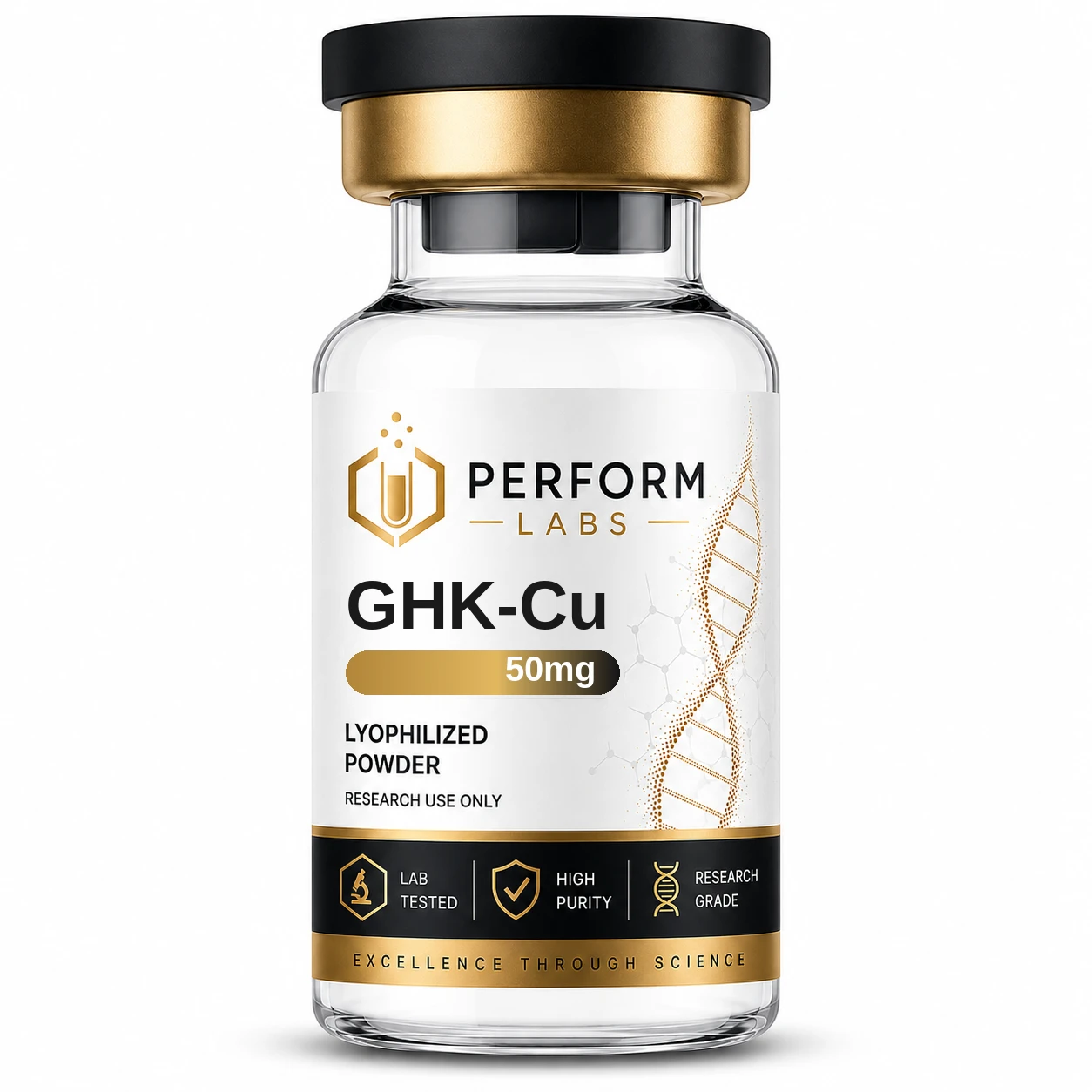
GHK-Cu research overview covering the copper-complex chemistry, published in-vitro signalling data, and analytical verification an Australian lab should expect.
GHK-Cu is the copper-bound complex of the tripeptide glycyl-l-histidyl-l-lysine (GHK), and it is one of the most extensively documented bioactive peptides in the published dermatological and tissue-signalling literature. First isolated from human plasma decades ago, GHK-Cu has since become a benchmark reference compound in Australian research work examining extracellular matrix regulation, antioxidant enzyme expression, and copper-dependent cell signalling.
The chemistry behind the complex
The GHK peptide sequence coordinates a divalent copper ion (Cu²⁺) through three donor sites: the imidazole nitrogen of the histidine side chain, the terminal amino group of glycine, and a deprotonated peptide backbone nitrogen. The resulting square-planar coordination complex is the biologically active species — not free GHK peptide and not free copper independently. This coordination geometry is also what gives correctly formed GHK-Cu its characteristic deep-blue colour, which functions as a simple qualitative check that the complex has assembled properly.
Published research signalling
- In cultured fibroblast models, GHK-Cu has been shown to modulate expression of genes linked to extracellular matrix turnover, including collagen and matrix metalloproteinase pathways.
- Published in-vitro work associates GHK-Cu with changes in superoxide dismutase (SOD) and other antioxidant enzyme expression.
- Laboratory binding studies report affinity between GHK-Cu and both collagen and decorin binding sites relevant to tissue-remodelling models.
- Cell-culture wound-model literature has reported associations between GHK-Cu exposure and angiogenic marker expression.
These findings are drawn from in-vitro and preclinical research literature and describe laboratory observations rather than established outcomes in humans — a distinction that matters when GHK-Cu findings are cited outside a strict research context.
Molecular identity
| Parameter | Reference Value |
|---|---|
| GHK peptide mass | 340.4 Da |
| Copper content (1:1 complex) | ≈ 17–20% by mass |
| Characteristic UV-Vis absorbance | ≈ 620 nm |
| Coordination geometry | Square-planar Cu²⁺ complex |
Why UV-Vis absorbance matters for verification
Unlike most research peptides, GHK-Cu offers a built-in optical verification method: correctly complexed material absorbs light at approximately 620 nm, producing the recognisable blue colour, and a UV-Vis spectrophotometer reading at this wavelength gives a fast qualitative check that the copper has actually coordinated with the peptide rather than existing as a physical mixture of free GHK and free copper salt in the same vial.
What a verified GHK-Cu Certificate of Analysis includes
- ≥98% HPLC purity of the underlying GHK peptide sequence
- Quantified copper content, consistent with the 1:1 complex ratio (approximately 17–20% by mass)
- LC-MS confirmation of the GHK peptide mass at 340.4 Da
- UV-Vis absorbance data at approximately 620 nm confirming complex formation
- Batch identifier and synthesis date matching the vial
Reconstitution and storage notes specific to GHK-Cu
GHK-Cu is generally supplied as a stable, pre-complexed lyophilised powder and reconstituted with bacteriostatic water following the same slow-addition technique used for other research peptides. Because the copper coordination complex is chemically distinct from a simple peptide chain, researchers should avoid pH extremes during reconstitution and handling, as substantial pH shifts can affect the stability of the copper-peptide coordination bond. Store lyophilised material at -20°C protected from light; reconstituted solution is generally documented as stable under refrigeration for several weeks, consistent with the compound's batch-specific COA.
Frequently asked research questions
Is GHK-Cu the same thing as the 'copper peptide' mentioned in skincare research?
Yes — 'copper peptide' and 'GHK copper peptide' both refer to the same GHK-Cu complex discussed throughout the dermatological research literature.
What does the blue colour of GHK-Cu indicate?
The deep blue colour is the visual signature of correctly coordinated Cu²⁺ within the GHK peptide structure and functions as a simple qualitative indicator that the complex has formed as intended.
How is GHK-Cu different from plain GHK peptide?
Plain GHK is the uncomplexed tripeptide; GHK-Cu is the copper-coordinated form, which is the biologically active species referenced throughout the published signalling literature.
Does pH affect GHK-Cu stability?
Yes — significant pH shifts can disrupt the copper-peptide coordination bond, so reconstitution and storage should avoid extreme pH conditions.