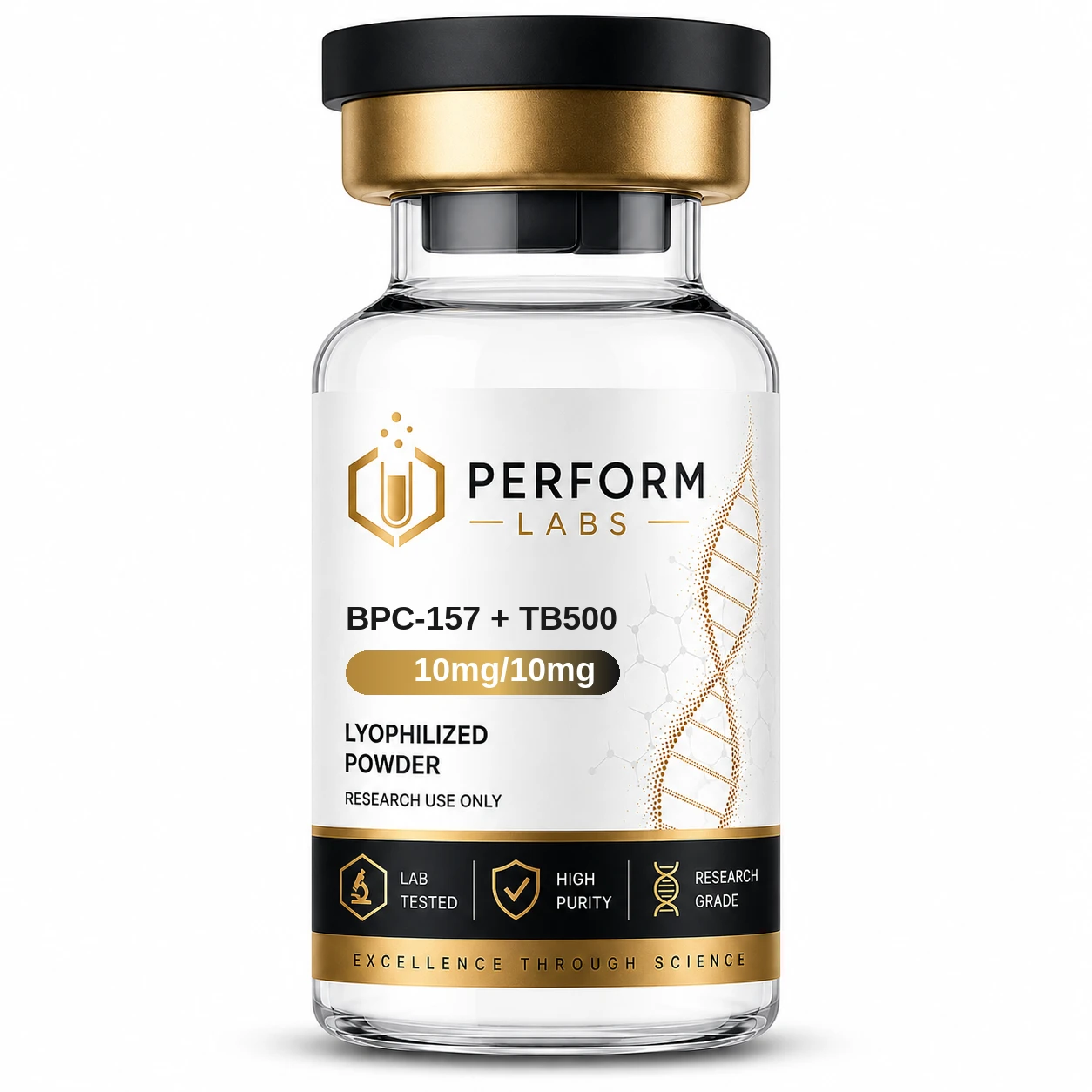
Why BPC-157 and TB-500 are frequently studied together in recovery and tissue-repair research, with mechanism, published signalling data and sourcing checkpoints for Australian labs.
BPC-157 and TB-500 are two of the most frequently co-referenced peptides in the Australian recovery-research literature. They are structurally unrelated, act on different signalling pathways, and are studied for genuinely different reasons — but published in-vitro and animal-model work has repeatedly examined them in combination on the theory that they act on complementary rather than overlapping repair mechanisms. This overview explains what each compound is, why researchers pair them, and what a laboratory should check before either enters a study protocol.
BPC-157: structure and signalling
BPC-157 (Body Protection Compound-157) is a synthetic pentadecapeptide — GEPPPGKPADDAGLV — derived from a partial sequence identified in human gastric juice protein. At approximately 1419.5 Da, it is a small, stable peptide with no disulfide bridges, which contributes to the notable acid and enzymatic stability reported across the published literature. Research models describe BPC-157 acting on angiogenesis-related pathways, including modulation of VEGFR2 expression, and on nitric-oxide-linked signalling relevant to tissue-repair models.
TB-500: structure and signalling
TB-500 is a synthetic fragment corresponding to the active region of Thymosin Beta-4, a naturally occurring 43-amino-acid protein. The synthetic fragment used in research work is typically the 17-amino-acid actin-binding domain, with a molecular mass in the region of 889 Da. Published in-vitro literature associates this fragment with actin regulation, cell migration, and modulation of angiogenic and anti-inflammatory signalling pathways — mechanisms that are frequently discussed alongside, but structurally distinct from, those attributed to BPC-157.
Why the two are studied in combination
- BPC-157's signalling is largely localised and stability-driven, while TB-500's actin-binding mechanism is systemic and cell-migration focused — researchers frequently frame this as complementary rather than duplicative.
- Published animal-model literature examining soft-tissue repair has assessed the two peptides both independently and in combination, with combination arms used to isolate additive versus independent effects.
- The two compounds do not share a chemical scaffold, so co-administration in a research protocol does not raise the same interaction concerns that structurally similar compounds might.
| Property | BPC-157 | TB-500 |
|---|---|---|
| Sequence length | 15 amino acids | 17 amino acids (active fragment) |
| Average mass | ≈ 1419.5 Da | ≈ 889 Da |
| Structural origin | Gastric juice protein fragment | Thymosin Beta-4 fragment |
| Primary published mechanism | Angiogenesis / VEGFR2 modulation | Actin regulation / cell migration |
Analytical verification for combination research
When a study protocol involves both peptides, documentation discipline becomes more important, not less. Each compound needs its own independently verified Certificate of Analysis — a shared or generic document covering both is a red flag. Labs should confirm:
- Separate batch identifiers for the BPC-157 vial and the TB-500 vial
- RP-HPLC purity of ≥98% (BPC-157 is commonly reported at ≥99%) for each compound independently
- LC-MS confirmed mass for each peptide against its own theoretical value
- Counterion identity (typically acetate) documented per batch
- Clear vial labelling to avoid cross-contamination when reconstituting both compounds in the same session
Reconstitution and storage reference
Both peptides are supplied lyophilised and reconstituted with bacteriostatic water using slow addition without agitation. Published storage references describe reconstituted BPC-157 and TB-500 as stable for approximately 20–30 days under refrigeration at 2–8°C, while lyophilised stock is documented as stable for 24 months or longer at -20°C, protected from light. Because the two are structurally unrelated, one compound's stability profile should never be assumed to apply to the other — always reference the individual COA.
Frequently asked research questions
Are BPC-157 and TB-500 the same compound?
No. They are structurally unrelated — BPC-157 is derived from a gastric juice protein fragment and TB-500 is derived from Thymosin Beta-4. They are studied together because their proposed mechanisms are considered complementary in the published literature.
Why are BPC-157 and TB-500 often researched together?
Published in-vitro and animal-model literature has examined the two in combination because their signalling pathways — angiogenesis-linked for BPC-157 and actin/cell-migration-linked for TB-500 — are proposed as complementary rather than overlapping.
Does combining them change reconstitution requirements?
No — each compound is reconstituted and stored according to its own Certificate of Analysis; combining them in a study does not change the individual handling requirements.
How do I verify the purity of each peptide in a combination study?
Request the batch-specific Certificate of Analysis for each compound separately and confirm RP-HPLC purity and LC-MS mass independently — never rely on a single combined document.